As a supplier of Zirconia Ceramic Foam Filters, I often encounter inquiries about the electrical conductivity of these remarkable products. In this blog post, I aim to delve into the topic of the electrical conductivity of Zirconia Ceramic Foam Filters, exploring its fundamentals, influencing factors, and practical implications. Zirconia Ceramic Foam Filter
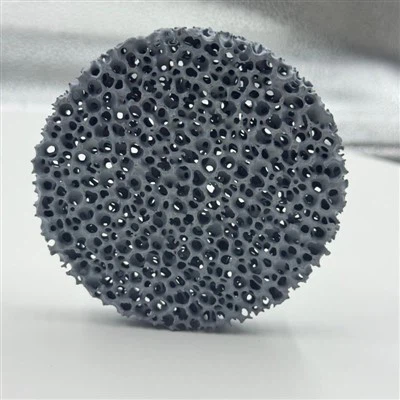
Understanding Zirconia Ceramic Foam Filters
Zirconia ceramic foam filters are porous materials made from zirconia (ZrO₂), a ceramic known for its high melting point, excellent chemical resistance, and mechanical strength. These filters are widely used in the metal casting industry to remove inclusions and impurities from molten metals, thereby improving the quality of castings. The unique structure of the foam filter, consisting of a three – dimensional network of interconnected pores, provides a large surface area for the capture of non – metallic inclusions.
Electrical Conductivity Basics
Electrical conductivity is a measure of a material’s ability to conduct an electric current. It is the reciprocal of electrical resistivity and is typically denoted by the symbol σ (sigma) with units of siemens per meter (S/m). In general, materials can be classified into three categories based on their electrical conductivity: conductors, semiconductors, and insulators.
Conductors, such as metals, have high electrical conductivity because they contain a large number of free electrons that can move easily in response to an applied electric field. Semiconductors have intermediate conductivity, which can be controlled by factors such as temperature, impurity doping, and external electric or magnetic fields. Insulators, on the other hand, have very low electrical conductivity due to the absence of free charge carriers.
Electrical Conductivity of Zirconia Ceramic Foam Filters
Zirconia in its pure form is an insulator with low electrical conductivity at room temperature. This is because the electrons in zirconia are tightly bound to the atoms, and there are few free charge carriers available to conduct an electric current. However, the electrical conductivity of zirconia can be significantly influenced by several factors, including temperature, doping, and crystal structure.
Temperature Effects
As the temperature increases, the electrical conductivity of zirconia ceramic foam filters also increases. At elevated temperatures, some of the electrons gain enough energy to break free from their atomic bonds and become mobile charge carriers. This phenomenon is known as thermal activation. In the case of zirconia, at high temperatures (e.g., above 1000 °C), the oxygen ions in the crystal lattice can also become mobile, contributing to ionic conduction.
The relationship between temperature and electrical conductivity follows an Arrhenius – type equation:
σ = σ₀ exp(-Eₐ / (RT))
where σ is the electrical conductivity at temperature T, σ₀ is a pre – exponential factor, Eₐ is the activation energy for conduction, R is the universal gas constant, and T is the absolute temperature.
Doping Effects
Doping zirconia with certain elements can significantly enhance its electrical conductivity. For example, adding yttrium oxide (Y₂O₃) to zirconia forms a solid solution known as yttria – stabilized zirconia (YSZ). The yttrium ions substitute for some of the zirconium ions in the crystal lattice, creating oxygen vacancies to maintain charge neutrality. These oxygen vacancies act as mobile charge carriers, increasing the ionic conductivity of the material.
The amount of dopant added can also affect the electrical conductivity. Optimal doping levels are usually determined through experimental studies to achieve the desired combination of conductivity and other material properties.
Crystal Structure Effects
Zirconia can exist in different crystal structures, including monoclinic, tetragonal, and cubic phases. The electrical conductivity of zirconia is closely related to its crystal structure. The cubic phase of zirconia, especially when stabilized by dopants, generally has higher electrical conductivity compared to the monoclinic and tetragonal phases. This is because the cubic structure provides a more symmetric and open lattice, facilitating the movement of ions.
Practical Implications of Electrical Conductivity in Zirconia Ceramic Foam Filters
In most applications of zirconia ceramic foam filters in the metal casting industry, electrical conductivity is not a primary consideration. The main function of these filters is to remove inclusions from molten metals, and their insulating properties at typical casting temperatures are actually beneficial to prevent electrical short – circuits and interference in the casting process.
However, in some specialized applications, such as in high – temperature electro – chemical devices, the electrical conductivity of zirconia ceramic foam filters can be exploited. For example, in solid oxide fuel cells (SOFCs), yttria – stabilized zirconia is commonly used as an electrolyte because of its high ionic conductivity at elevated temperatures. The foam structure of the zirconia filter can provide additional advantages, such as a large surface area for electrochemical reactions and improved mass transport.
Product Performance and Electrical Conductivity
As a supplier, we take great care to ensure the quality and performance of our Zirconia Ceramic Foam Filters. Although electrical conductivity is not the main performance指标 for normal casting applications, we still monitor and control the factors that may affect it during the manufacturing process.
We carefully select the raw materials and doping elements to ensure the stability of the crystal structure and the desired electrical properties if needed. Our manufacturing process includes precise temperature control during sintering, which is crucial for achieving the proper crystal phase and optimizing the material’s performance.
Conclusion

The electrical conductivity of Zirconia Ceramic Foam Filters is a complex property that is influenced by temperature, doping, and crystal structure. While in most metal casting applications, the insulating nature of these filters is advantageous, in specialized high – temperature electro – chemical applications, the enhanced conductivity achieved through doping and proper processing can be utilized.
Extruded Ceramic Filter If you are interested in our Zirconia Ceramic Foam Filters for your specific application, whether it is for traditional metal casting or more advanced electro – chemical uses, I encourage you to contact us for a detailed discussion. We are committed to providing high – quality products and professional solutions to meet your needs. Feel free to reach out for procurement negotiations.
References
- K. E. Heuer and A. H. Heuer, "Zirconia Ceramics: A Review of Their Science, Technology, and Applications," Annual Review of Materials Science, vol. 10, pp. 137 – 170, 1980.
- S. C. Singhal and K. Kendall, "High – Temperature Solid Oxide Fuel Cells: Fundamentals, Design, and Applications," Elsevier, 2003.
- R. W. Cahn, P. Haasen, and E. J. Kramer, "Materials Science and Technology: A Comprehensive Treatment," vols. 1 – 18, VCH, 1990 – 1998.
Shanxi Dingtai Yinrui Filter Manufacturing Co., Ltd.
As one of the most professional zirconia ceramic foam filter manufacturers and suppliers in China, we’re featured by quality products and good service. Please feel free to buy high-grade zirconia ceramic foam filter made in China here from our factory. Contact us for more details.
Address: Plant 1-2, No.3 Xuhu Business and Trade Industrial Park, Houma Economic Development Zone, Linfen, Shanxi, China
E-mail: tina@dtcastingfilters.com
WebSite: https://www.dingtaifilter.com/
